Lifespan of a Saddle
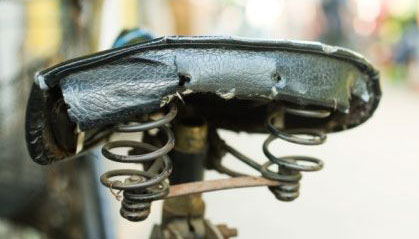
How long should a bike saddle last? Most riders guess around 10,000 miles — about what you’d expect from a frame, bar, or seatpost. A saddle isn’t like those parts.
It has a job none of them share: it’s the interface between your body and a hard frame, so it has to be both rugged and comfortable for the whole ride. That’s a difficult balance. The rails, base, cover, and foam all have to flex to feel good — and that same flex is what slowly fatigues and wears them out. Rigid metal rails last almost forever, but rigid parts mean a harsher ride. The real trick is the balance between comfort and durability.
Koobi saddles are built for an optimum comfort lifespan of 400 to 600 hours. That doesn’t mean the saddle is finished at 400 hours — we regularly ride ours well past 600 — but comfort starts to fade around the 400-hour mark. Foam breaks down so gradually that most riders never notice; they just feel a little more discomfort without knowing what changed.
Replace your saddle around 400 hours and you’ll likely feel the difference. After 600 hours, that difference is significant.
Think Ferrari versus Jeep. It’s hard to get Ferrari ride quality with Jeep durability at a price that’s still reasonable. We’ve built Koobi saddles with the comfort components that deliver up to your 400th hour of riding pleasure — and if you run the numbers, you only have to average 25 mph to reach that 10,000-mile guess anyway.
One more way to look at it: plenty of riders spend $100 on bib shorts that last a quarter as long as a good saddle. At that rate, every Koobi is worth about four pairs. Not a bad deal.
What Makes a Saddle Comfortable?
So what actually makes a bike saddle comfortable? Is it the shape? The firmness? The width? The cover material? The rails? The answer is all of the above. Comfort comes from these elements working together — and how they add up depends on the rider.
Shape. A saddle's contours, width, and length all shape how it feels. Width in particular has been oversold as the secret to comfort. Different widths do feel different, and riders do have a range of sit-bone widths — but the idea that a saddle is uncomfortable simply because its width doesn't match your sit bones isn't backed by independent research. Most riders are comfortable across a range of widths. The contours matter every bit as much as the number on a width chart.
Padding and firmness. Here's where the biggest myth lives: that softer foam is more comfortable. It doesn't play out that way. All foam gradually collapses over the course of a ride, and how fast it collapses depends on your weight, how long you're out, and the firmness and age of the foam. So the heavier you are and the longer you ride, the more a firm saddle actually pays off. Ride less and weigh less, and softer foam tends to feel better. Some saddles add a layer of gel over the foam to fine-tune the feel.
Relief channel. Koobi introduced the full-relief saddle to cycling in 1998. A proper relief cutout takes pressure off the soft tissue — often the difference between numbness and a comfortable long ride.
Cover. From thick leather to thin, highly flexible Lycra, the cover material changes how a saddle feels. Manufacturers are always balancing three things: durability, flexibility, and cost.
Rails. The most misunderstood part of the saddle. Done right, rails are meant to flex — like the leaf springs on a pickup truck — absorbing bumps and road vibration. The ideal rail matches its stiffness to the rider's weight. The trouble is that a manufacturer has no idea whether the person buying the saddle weighs 120 pounds, 220, or 320, so most rails are built for a rider around 250 pounds. The further your weight is from that, the harsher the ride. Koobi's PRS technology solves this by placing a rubber spring — an elastomer — between the base and the rail. When you order, we custom-build the saddle with one of five elastomer springs, matching the ride stiffness much more closely to your actual weight.
How to Choose
Most of these elements you can judge for yourself by looking closely at a saddle and, ideally, test riding it. Just know that a test ride can mislead: many saddles have a break-in period, so how one feels on a spin around the parking lot can change over the miles.
Here's the rule of thumb we use at Koobi — the longer the ride and the heavier the rider, the firmer the saddle:
Under 3 hours a week: go soft
3 to 6 hours a week: go medium
Consistently over 6 hours a week: go firm
Your body weight nudges this up or down. Width is best sorted out through trial and error, and Koobi's PRS technology takes care of rail stiffness for you. A couple of caveats: for indoor cycling, go a step softer — and for triathlon, it's pretty much the same as the road.